Table of Contents
Introduction
Choosing commercial carpet for a hotel, exhibition venue, office, retail space, event hall, showroom, or other public environment involves far more than selecting a suitable color or surface pattern. A carpet that looks appropriate in a small sample may behave very differently once it is installed across a large floor area and exposed to continuous foot traffic, cleaning, temporary fixtures, rolling equipment, or project-specific safety requirements.
For contractors, distributors, project buyers, and private-label brands, the most important question is therefore not simply whether a carpet looks attractive. The real issue is whether its fiber, construction, weight, thickness, surface structure, dimensions, backing, performance requirements, and production consistency match the intended application.
A clear commercial carpet specification helps turn subjective expectations into measurable production requirements. It gives manufacturers a more precise basis for sampling and production while allowing buyers to compare products more effectively.
This guide explains the main commercial carpet specifications project buyers should confirm before approving samples or moving into bulk production.
Start With the Application Before Choosing a Carpet
Different commercial environments place very different demands on flooring.
A carpet used for a three-day exhibition does not necessarily require the same construction as flooring installed in a hotel corridor for several years. Exhibition projects may prioritize fast installation, manageable roll dimensions, consistent color, controlled material weight, and convenient removal. Hospitality interiors may place more emphasis on appearance retention, texture, pattern coordination, and long-term visual consistency.
Retail stores, event spaces, offices, and public facilities introduce additional considerations. Flooring may need to accommodate customer circulation, display systems, wheeled equipment, frequent cleaning, or different levels of foot traffic.
Before deciding on fiber, weight, backing, or color, buyers should first define the actual project conditions, including:
- installation location;
- temporary or long-term use;
- expected foot traffic;
- required service period;
- subfloor conditions;
- cleaning methods;
- installation method;
- visual requirements;
- applicable performance standards.
Once these factors are clear, the commercial carpet specification can be built around the real application rather than around appearance alone.
Understand Carpet Construction Before Comparing Products
Two commercial carpets can look similar in a photograph while using very different manufacturing structures.
Construction affects surface appearance, density, dimensional stability, flexibility, production efficiency, and suitability for different applications.
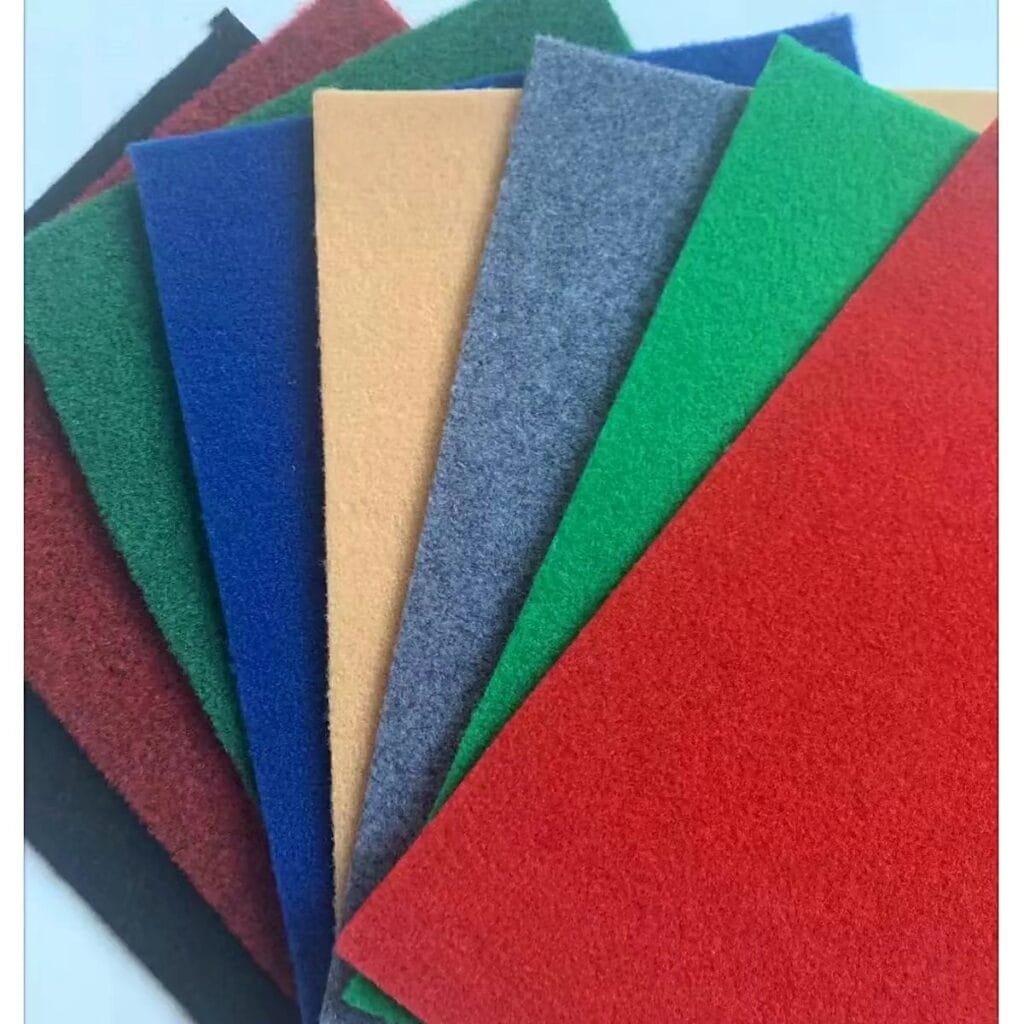
Needle-punched construction is commonly used for exhibition, event, and practical commercial flooring. Fibers are mechanically entangled through repeated needle penetration to create a stable textile structure. By adjusting fiber type, fiber quantity, needle density, finishing, backing, and surface treatment, manufacturers can produce carpets with different weights, textures, and performance characteristics.
For projects that require a more refined surface appearance, products such as velour carpet can provide a softer-looking finish while still supporting commercial and customized applications.
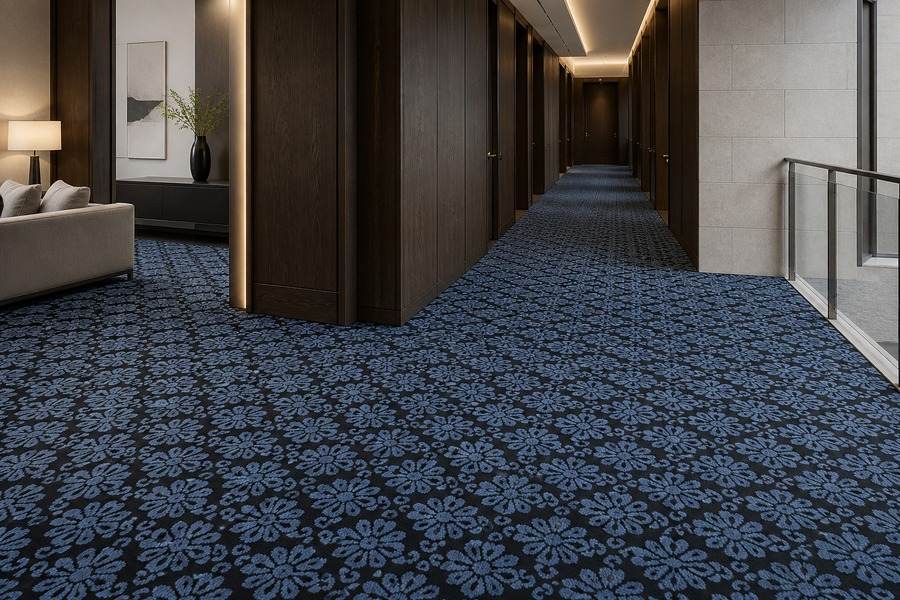
Patterned commercial carpet requires further consideration because surface design becomes part of the technical specification. Pattern scale, repeat consistency, direction, color coordination, and installation orientation should all be confirmed before bulk production.
This is why buyers should avoid using a broad product description such as “commercial carpet” as the complete specification. The manufacturing construction should also be clearly defined.
Fiber Material Should Match the Application
Fiber composition influences the appearance, handling, maintenance requirements, resilience, and production characteristics of commercial carpet.
Polyester is commonly used in needle-punched commercial and exhibition carpets because it supports a wide range of colors and surface designs. Other fiber systems may be selected depending on the construction and intended application.
However, the material name itself should never be treated as a complete indicator of quality.
Two polyester carpets, for example, can perform very differently if they have different weights, densities, thicknesses, needle-punching structures, backing systems, or finishing treatments.
When evaluating samples, buyers should confirm the actual fiber composition together with the complete carpet structure. If the project involves special color requirements, flame-retardant treatment, backing compatibility, or specific testing, these conditions should be communicated before the sample is finalized.
The right commercial carpet material is therefore the one that works effectively within the complete project specification.
Carpet Weight Matters, but Higher GSM Is Not Always Better
GSM, or grams per square meter, is one of the most common measurements used when sourcing commercial carpet.
It provides a useful indication of how much material is present within a defined surface area, but it should not be treated as a universal quality score.
A heavier carpet may contain more fiber or use a denser structure, but that does not automatically make it more suitable for every project. Two carpets with similar GSM figures can still feel and perform differently because of variations in fiber composition, thickness, surface density, manufacturing structure, and finishing.
For temporary exhibitions, an unnecessarily heavy carpet can increase handling and transportation requirements without providing a meaningful project advantage. On the other hand, decorative commercial interiors may require a fuller surface structure to achieve the desired visual effect.
Buyers should therefore select GSM according to the application rather than simply requesting the highest available specification.
Once a sample is approved, the agreed weight and production tolerance should also be included in the final product specification.
Pile Height, Thickness, Density and Weight Are Different Specifications
Commercial carpet specifications can become confusing when pile height, total thickness, density, and GSM are treated as interchangeable terms.
They describe different characteristics.
Pile height refers to the height of the visible carpet surface where the construction has a defined pile. Total thickness measures the overall vertical dimension of the carpet. Density describes how closely the fibers or yarns are arranged within the structure, while GSM measures the product weight per square meter.
These characteristics can influence one another, but none of them can replace the others.
A low-pile commercial carpet can still have a dense and stable structure. A thicker carpet is not automatically more durable, and a heavier carpet does not necessarily have a taller pile.
This distinction matters particularly in projects involving door clearance, transitions between different flooring materials, wheeled traffic, temporary exhibition structures, or raised display systems.
For this reason, buyers should request measurable technical information rather than descriptions such as “thick,” “heavy,” or “premium.”
Width and Roll Length Affect Installation Efficiency
Roll dimensions are not only logistics information. They can directly affect material utilization, seam quantity, cutting efficiency, handling, and installation time.
Consider a large exhibition hall. If the carpet width does not match the booth layout or floor plan, installers may need more cutting and joining. This can create additional labor and material waste.
The same principle applies to offices, showrooms, retail spaces, hotels, and other large commercial interiors.
Before confirming production, buyers should consider how roll width and roll length fit the actual installation layout.
| Specification | Why It Matters |
|---|---|
| Roll width | Influences seams, cutting layout and material utilization |
| Roll length | Affects handling, installation planning and project allocation |
| Total quantity | Should reflect floor area and installation allowance |
| Pattern direction | Important for stripes and directional designs |
| Batch allocation | Helps maintain consistency across connected spaces |
| Packing method | Affects transportation, storage and site handling |
Custom dimensions should therefore be planned around the installation environment rather than selected independently.
Color Approval Should Not Rely Only on Screen Images
Color is one of the most common sources of misunderstanding in textile projects.
A carpet color displayed on a phone, computer monitor, digital catalog, or product photograph can vary because of screen calibration, photography conditions, editing, lighting, and surrounding colors.
Commercial carpet can also look different under natural daylight, warm hotel lighting, exhibition lighting, or large-area installation.
For projects where color consistency is important, physical sample approval is far more reliable than digital reference alone.
The visible color can also be influenced by surface structure, fiber direction, texture, density, and viewing angle. The same color reference may appear different on a flat exhibition carpet and a textured decorative carpet.
Large commercial projects should therefore establish an approved physical color reference before production and clarify acceptable tolerances where required.
Pattern Scale Should Be Evaluated Across the Whole Space
Patterned carpet requires more planning than plain-color flooring.
A design that looks balanced on a small sample may create a very different visual effect when installed across hundreds or thousands of square meters.
Small pattern repeats can create a more continuous and uniform surface, while larger geometric or decorative motifs can become prominent elements of the interior design.
Directional patterns introduce another requirement: installation orientation.
Stripes, geometric repeats, and jacquard patterns should normally follow a consistent direction across connected sections of the project.
For projects requiring more decorative surface variation, jacquard carpet can support patterned commercial interiors, hospitality applications, exhibitions, and other spaces where visual design is an important part of the flooring specification.
Before production, buyers should confirm pattern scale, repeat, direction, color combination, dimensions, and sample appearance.
Backing Should Match the Subfloor and Installation Method
Backing can influence grip, flexibility, dimensional stability, moisture behavior, handling, and compatibility with the installation surface.
Not every commercial carpet requires the same backing structure.
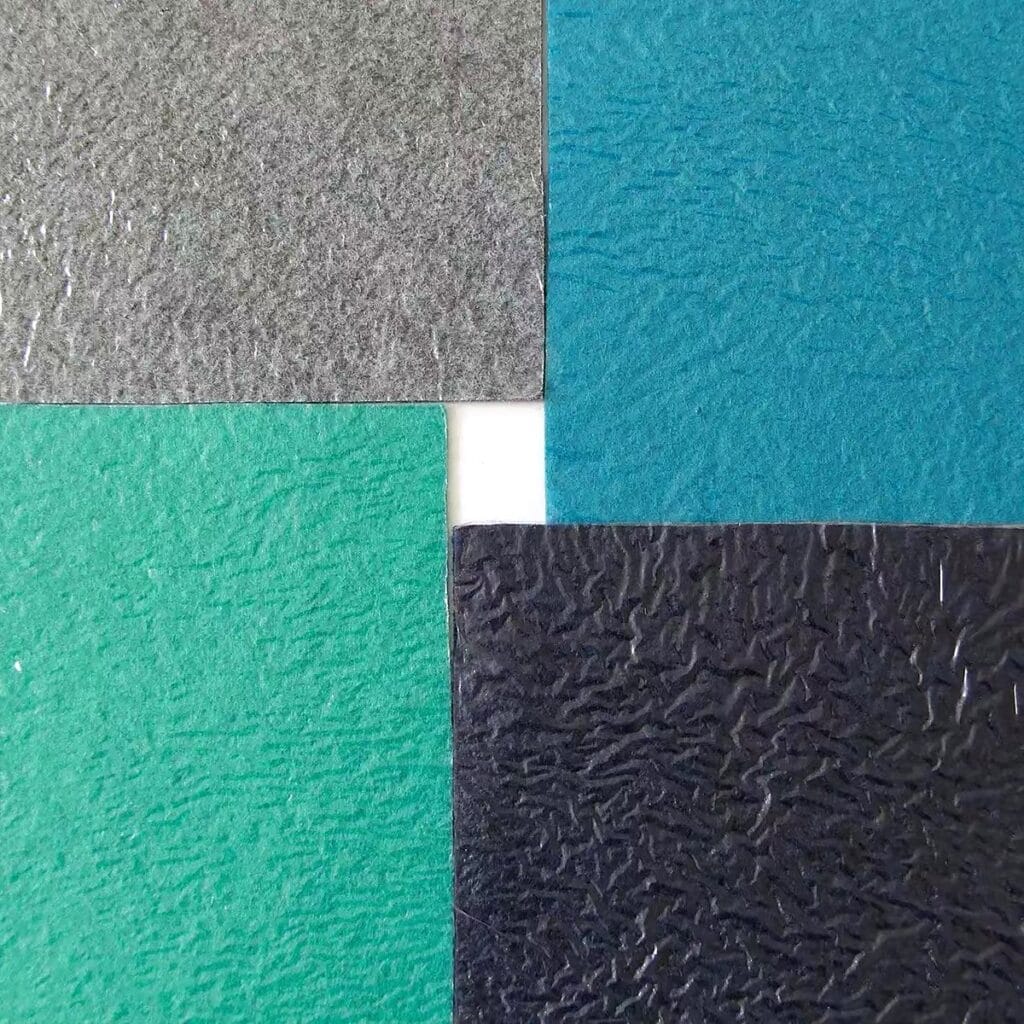
Some needle-punched products may be suitable for temporary commercial applications without a heavy secondary backing, while carpet mats and specialized floor-covering products may use TPE, TPR, PVC, or other backing materials.
Before selecting a backing, buyers should consider:
- the subfloor material;
- temporary or permanent installation;
- whether the carpet will be loose-laid or fixed;
- moisture exposure;
- slip resistance requirements;
- replacement frequency;
- handling requirements.
A backing should therefore be selected as part of the total flooring system rather than as an isolated product feature.
Fire Performance Must Be Clearly Defined
Terms such as “fire resistant,” “flame retardant,” and “fireproof” should not be used as though they mean exactly the same thing.
Commercial flooring projects may need to comply with different test methods, building requirements, safety regulations, or documentation standards depending on the destination market and installation environment.
The Carpet and Rug Institute provides useful information through its commercial carpet installation standards, which cover important considerations related to installation planning, site conditions, and commercial flooring practices.
However, buyers should still confirm the exact fire-performance standards, testing requirements, and documentation required by their own market or project.
If a project requires flame-retardant carpet, the required test method should ideally be communicated before sampling. This allows the manufacturer to evaluate the material, treatment, construction, and testing requirements during product development.
Simply requesting a “fireproof carpet” without identifying the actual required standard can create unnecessary uncertainty during production.
Installation Conditions Should Be Considered Before Production
A suitable commercial carpet can still produce unsatisfactory results if installation conditions are ignored.
Subfloor cleanliness, moisture, temperature, adhesive compatibility, seam placement, carpet direction, cutting methods, and acclimation can all influence the finished installation.
Large projects should therefore connect product selection with installation planning at an early stage.
If the site includes irregular rooms, ramps, columns, temporary booths, stage structures, multiple connected spaces, or transitions between different floor finishes, these conditions should be considered when calculating carpet dimensions and quantities.
This approach allows project teams to treat carpet as part of a complete flooring system rather than as an isolated textile product.
It also makes it easier to distinguish between manufacturing-related issues and installation-related issues if problems are identified after installation.
Maintenance Requirements Should Influence Carpet Selection
Commercial carpet should also be selected according to how it will be maintained after installation.
An exhibition carpet may experience intense traffic during a short event and then be removed. A hotel, office, or retail environment may require regular cleaning over a much longer period.
Surface color, texture, pile structure, fiber composition, traffic patterns, and entrance-zone management can all influence how the carpet looks over time.
Before selecting a product, project teams should consider who will maintain the flooring, how frequently it will be cleaned, what equipment will be used, and what types of soil or contamination are likely to occur.
A suitable commercial carpet should not only look appropriate when it is first installed. It should also fit the practical maintenance conditions of the space.
What Should a Commercial Carpet Specification Sheet Include?
A strong specification sheet converts project expectations into measurable production information.
The exact requirements will vary by application, but the following items should normally be considered.
| Item | Information to Confirm |
|---|---|
| Application | Exhibition, hotel, office, retail, event or other commercial space |
| Construction | Needle-punched, velour, patterned or other structure |
| Fiber | Required fiber composition |
| Weight | Target GSM and acceptable tolerance |
| Thickness | Required total thickness or pile measurement |
| Surface | Plain, velour, stripe, jacquard or other finish |
| Color | Standard color, sample reference or custom color |
| Pattern | Design, repeat and direction where applicable |
| Width | Required roll width |
| Length | Required roll length |
| Backing | Backing type where required |
| Performance | Fire, grip or other project requirements |
| Packing | Roll protection, labels and identification |
| Quantity | Total project requirement |
| Sample | Approved reference for bulk production |
Any characteristic that will affect final acceptance should be documented before mass production begins.
Sample Approval Is More Useful Than Promotional Descriptions
For customized commercial carpet, a physical sample often provides more practical information than a long product description.
A properly approved sample allows buyers to evaluate material, color, surface appearance, weight, thickness, pattern, backing, and workmanship using the same physical reference that the manufacturer can follow during production.
However, the sample should not replace the written specification.
A physical sample may not communicate details such as roll dimensions, packing requirements, labels, quantity allocation, acceptable tolerances, testing requirements, or project documentation.
For this reason, a reliable commercial carpet approval process combines:
an approved physical sample + a clearly documented specification sheet.
Together, these provide a more objective reference for production and inspection.
Common Commercial Carpet Sourcing Mistakes
Many sourcing problems begin during specification rather than manufacturing.
One common mistake is selecting carpet entirely from photographs. Digital images can help during early product selection, but they cannot accurately communicate thickness, density, backing feel, actual color, or surface structure.
Another mistake is judging quality only by GSM. Carpet weight is useful information, but it cannot replace construction, fiber, thickness, density, surface treatment, and backing.
Buyers may also request a generic “high-quality commercial carpet” without defining what quality means for the project. A short-term exhibition and a decorative hotel interior can both require good-quality carpet, but the technical criteria may be very different.
Another frequent problem is communicating special requirements too late. Flame-retardant performance, custom backing, unusual dimensions, special packaging, labeling, or testing documentation should ideally be discussed before sample approval.
Clear specifications reduce these risks and make comparison between suppliers and samples much easier.
How Customization Works in Commercial Carpet Projects
Commercial carpet customization can involve much more than changing a color or adding a logo.
Depending on the product structure, customization can include fiber type, color, pattern, GSM, thickness, surface finish, width, roll length, backing, labels, and packaging.
This is particularly useful for distributors, contractors, project suppliers, and private-label brands that need a consistent product specification across recurring orders or different markets.
An effective customization process begins with the application.
When the manufacturer understands the installation location, traffic conditions, desired appearance, project duration, destination market, installation method, and required performance, individual specifications can be coordinated more effectively.
This produces a more complete commercial carpet solution than selecting each technical parameter independently.
Conclusion
Selecting commercial carpet is ultimately a technical specification process rather than a purely visual purchasing decision.
Fiber composition, manufacturing construction, GSM, thickness, density, surface structure, roll dimensions, backing, color, pattern, fire-performance requirements, installation conditions, maintenance, and packaging all influence whether a product is suitable for a particular commercial project.
The most effective sourcing process begins by defining the real application, translating those requirements into measurable specifications, confirming critical details through physical samples, and using the approved specification as the standard for bulk production.
For exhibitions, hotels, offices, retail spaces, event venues, showrooms, and other commercial environments, this approach helps project buyers evaluate carpet more accurately and reduces uncertainty between sampling, manufacturing, installation, and final acceptance.
FAQ
What is commercial carpet?
Commercial carpet is carpet designed or specified for non-residential environments such as hotels, offices, exhibitions, retail spaces, public buildings, event venues, and commercial interiors. Different commercial applications may require different materials, weights, surface structures, backing systems, and performance characteristics.
What GSM is suitable for commercial carpet?
There is no single GSM that is suitable for every commercial carpet application. The appropriate weight depends on the construction, fiber, traffic conditions, installation period, required appearance, and other project requirements. GSM should be evaluated together with thickness, density, and surface structure.
Is heavier commercial carpet always better?
No. Higher weight does not automatically mean better performance. Carpet construction, fiber type, density, surface treatment, backing, and intended application are also important. A lighter carpet may be more suitable for some temporary exhibition applications, while a different specification may be required for longer-term commercial interiors.
What should buyers confirm before ordering commercial carpet?
Buyers should confirm the application, construction, fiber composition, GSM, thickness, surface finish, color, pattern, roll width, roll length, backing, performance requirements, packaging, quantity, and approved sample before bulk production.
What is the difference between commercial carpet and exhibition carpet?
Commercial carpet is a broad category covering flooring used in hotels, offices, retail spaces, exhibitions, events, and other non-residential environments. Exhibition carpet is usually designed around temporary event requirements such as efficient installation, large-area coverage, roll handling, controlled weight, and easy removal.
Can commercial carpet be customized?
Yes. Depending on the manufacturing structure, commercial carpet can be customized in color, pattern, weight, dimensions, surface finish, backing, labels, and packaging. Available customization options should be confirmed according to the specific product and project requirements.